![[Image]SANEI HYTECHS](/en/shared/img/logo_w.png)
What is a Power Management IC (PMIC)? A Beginner's Guide to the Semiconductor Industry
2026.02.18
- LSI Circuit Design
Power management ICs are essential knowledge for those new to the semiconductor industry or those wishing to learn the fundamental technologies of electronic devices. These components, which control the "power" at the heart of all electronic devices that support our daily lives, such as smartphones, PCs, and home appliances, play a vital role in ensuring the stable operation of these products.
This article provides a beginner-friendly explanation of the basic functions and types of power management ICs, as well as the latest technological trends.
This article provides a beginner-friendly explanation of the basic functions and types of power management ICs, as well as the latest technological trends.
* IC: Integrated Circuit
What is a Power Management IC?
Fundamental Technology for Stable Operation of Electronics
A power management IC is a "voltage regulator" that stably supplies the power required by electronic devices. Its role is to convert and adjust electricity from outlets or batteries into a format that is easy for each device to use.
Definition of Power Management ICs and Familiar Examples
A power management IC is an integrated circuit designed to steadily supply the power required by electronic devices. For example, it plays the role of regulating and supplying power from household outlets or batteries to the appropriate voltage and current so that devices like home appliances, PCs, and smartphones can operate normally.
Taking a USB charger as an example, it converts 100V AC into DC voltage using a rectifier and a filter circuit. After that, a power management IC is used to stabilize the output to a specific voltage that complies with USB standards.
Power management ICs commonly available on the market include devices and components (linear regulators, switching regulators, etc.) called DC-DC converters that convert DC power supply voltage, as well as components (switching regulators) called ACDC converters that convert alternating current (AC) voltage from outlets and other sources into direct current (DC) voltage that can be used by electronic devices.
Taking a USB charger as an example, it converts 100V AC into DC voltage using a rectifier and a filter circuit. After that, a power management IC is used to stabilize the output to a specific voltage that complies with USB standards.
Power management ICs commonly available on the market include devices and components (linear regulators, switching regulators, etc.) called DC-DC converters that convert DC power supply voltage, as well as components (switching regulators) called ACDC converters that convert alternating current (AC) voltage from outlets and other sources into direct current (DC) voltage that can be used by electronic devices.
* Linear regulator: A control method that dissipates voltage as heat. Although it has low efficiency, it has a simple circuit configuration and produces very little noise, making it suitable for applications requiring a high-quality power supply.
* Switching regulator: A method of converting voltage by switching a switch on and off at high speed. The circuit configuration is complex and generates noise, but it has extremely high conversion efficiency and can supply large amounts of power while suppressing heat generation. This method is generally referred to as a "DC-DC converter."
* Switching regulator: A method of converting voltage by switching a switch on and off at high speed. The circuit configuration is complex and generates noise, but it has extremely high conversion efficiency and can supply large amounts of power while suppressing heat generation. This method is generally referred to as a "DC-DC converter."
Why are Power Management ICs Necessary?
Ensuring Stable Supply and Responding to Load Fluctuations
Power management ICs are necessary to maintain a constant voltage despite fluctuations in input voltage or changes in the device's operating load. This protects sensitive semiconductor components from malfunctions or damage.
The Importance of Maintaining Constant Voltage
The primary role of a power management IC is to provide a stable voltage required for device operation, regardless of fluctuations in input voltage or the current consumed by the connected device (load). This prevents malfunctions in precision electronic circuits.
Generally, the power supply system of electronic devices does not have a constant voltage. For instance, in battery-powered devices, the input voltage gradually drops as the remaining charge decreases. Additionally, when internal components like the CPU operate under high load, the output voltage may temporarily fluctuate due to sudden changes in current consumption.
Such fluctuations can cause malfunctions or performance degradation in precision electronic circuits, such as CPUs and microcontrollers composed of minute semiconductors. Therefore, power management ICs are required to control and maintain a constant output voltage regardless of input fluctuations or output load.
Generally, the power supply system of electronic devices does not have a constant voltage. For instance, in battery-powered devices, the input voltage gradually drops as the remaining charge decreases. Additionally, when internal components like the CPU operate under high load, the output voltage may temporarily fluctuate due to sudden changes in current consumption.
Such fluctuations can cause malfunctions or performance degradation in precision electronic circuits, such as CPUs and microcontrollers composed of minute semiconductors. Therefore, power management ICs are required to control and maintain a constant output voltage regardless of input fluctuations or output load.
* CPU: Central Processing Unit / The Central Processing Unit, commonly found in devices such as PCs.
* Microcontroller: A single-chip device that integrates a CPU with peripheral circuits such as memory and interfaces.
* Microcontroller: A single-chip device that integrates a CPU with peripheral circuits such as memory and interfaces.

Types and Operating Principles of Power Management ICs
Deep Dive into Switching Regulators
There are several types of power management ICs, and "switching regulators" in particular are capable of highly efficient power conversion. Depending on the application, they are used as "Buck" (step-down), "Boost" (step-up), or "Buck-Boost" (automatic switching).
Characteristics, Merits, and Demerits of Each Method
There are several types of power management ICs, including ACDCs, linear regulators, switching regulators, and charge pumps. Linear regulators have low noise and simple circuits, while switching regulators are highly efficient, so they are used as needed.
Depending on their operating principle, switching regulators can be used as buck (which reduces voltage), boost (which increases voltage), or buck-boost (which automatically switches between the two), achieving highly efficient power conversion. The main characteristics, merits, and demerits of each method are as follows:
Depending on their operating principle, switching regulators can be used as buck (which reduces voltage), boost (which increases voltage), or buck-boost (which automatically switches between the two), achieving highly efficient power conversion. The main characteristics, merits, and demerits of each method are as follows:
Buck (Step-Down)
| Main Features | Generates a voltage lower than the input voltage. |
|---|---|
| Advantages | Highly efficient and generates little heat. Simple circuit. |
| Disadvantages | Can only output voltages lower than the input voltage. |
| Typical Applications | Internal power supplies for PCs, smartphones, etc., secondary side of AC adapters, etc. |
Boost (Step-Up)
| Main Features | Generates a voltage higher than the input voltage. |
|---|---|
| Advantages | High voltage can be generated from a single 1.5V battery. The circuit is simple. |
| Disadvantages | Cannot drop below the input voltage. |
| Typical Applications | Battery-powered devices, LED drive circuits, etc. |
Buck(Step-Down) and Boost(Step-Up)
| Main Features | Equipped with both step-down and step-up functions. |
|---|---|
| Advantages | A constant voltage can be maintained even when the battery is depleted and the voltage drops. |
| Disadvantages | Efficiency is somewhat low. The circuit tends to be complex and large, and the increased number of components means higher costs. |
| Typical Applications | Used in automotive equipment, solar charging, lithium battery-powered equipment, etc. |
Where are Power Management ICs Used? (Case Studies)
Power management ICs are used in all kinds of electronic devices, including PCs, smartphones, and IoT devices. Especially in products with complex functions, multiple power management ICs are combined to deliver optimal electricity to each internal component.
Examples of Use in PCs and IoT Devices
From battery-powered mobile devices, PCs, and IoT (Internet of Things) devices to automotive applications, power management ICs are responsible for optimizing power supply within various electronic devices and are used in a wide range of applications. The diagram below shows a simplified power configuration of a PC, assuming power is supplied from a household outlet. This section introduces power management IC applications, including examples of linear regulators and step-down and step-up switching regulators based on power supply systems.
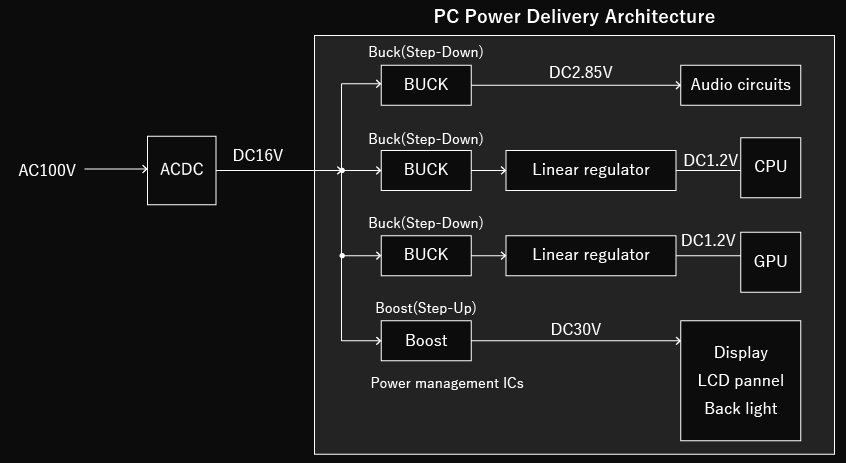
AC power supplied from an outlet (e.g., AC 100V) is converted into DC voltage (e.g., DC 16V) by an AC-DC converter. Then, inside the board, various components such as the CPU, GPU, and audio circuits are installed, and multiple different voltages (e.g. 1.2V, 2.85V) must be generated using step-down switching regulators and linear regulators. Also, a higher voltage (e.g. 30.0V) may be required to drive the display backlight (LCD panel), in which case a step-up switching regulator is used. In multi-functional products like PCs, multiple power management ICs must work together to supply the optimal power to each component. Next, we will introduce an example of how to use a buck-boost switching regulator, using an environmental measurement board for IoT applications such as energy harvesting (environmental power generation) where the input voltage fluctuates.
* GPU: A Graphics Processing Unit designed to accelerate the rendering of images and videos on a computer.
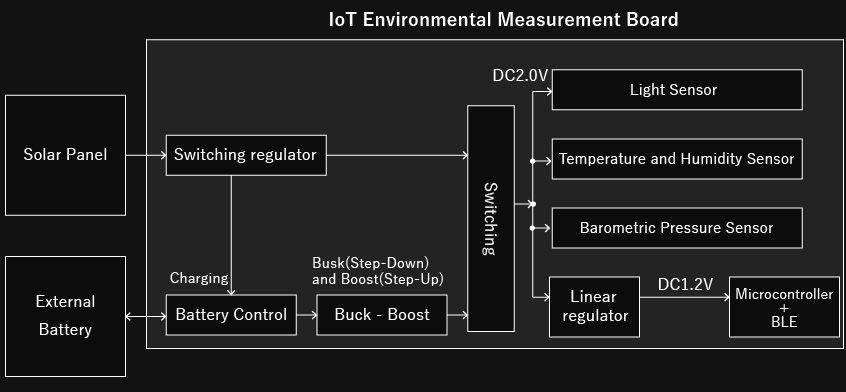
During the daytime when the sun is out, this board charges an external battery with power obtained from the solar panel, and supplies voltage (e.g. 2.0V) to necessary devices (various measurement devices such as light sensors, temperature/humidity/barometric pressure sensors, and microcontrollers (BLE+MCU)) via a linear regulator and switching regulator.
At night, the supply from the solar panel stops, and the system switches to the charged battery. If charging is insufficient during the day, it may not be possible to cover nighttime consumption and the voltage may fall below the required level. However, by using a buck-boost switching regulator, it is possible to extend operating time without worrying about voltage drops.
At night, the supply from the solar panel stops, and the system switches to the charged battery. If charging is insufficient during the day, it may not be possible to cover nighttime consumption and the voltage may fall below the required level. However, by using a buck-boost switching regulator, it is possible to extend operating time without worrying about voltage drops.
The Future of Power Management ICs
Green Technology and the Evolution of IoT
To realize a decarbonized society, power management ICs are required to have even higher "energy-saving performance." Especially with the spread of IoT devices using environmental energy, ultra-low-power technology is becoming increasingly critical.
Energy Harvesting and Power Saving
Currently, the promotion of green technology (realization of a decarbonized society) is accelerating worldwide. Power management ICs play an extremely important role from the perspective of energy efficiency in the movement to reduce environmental impact. In recent years, there has been an increase in IoT products that use energy harvesting (environmental power generation), and it is expected that an increasing number of sustainable IoT devices will be developed by eliminating the need for battery replacement. The power management ICs used in these devices require technology that can harvest weak energy from the environment, such as sunlight, heat, and vibration, and convert it into a stable voltage so that it can be used as electricity.
The power harvested from the environment is very unstable and weak. For this reason, ultra-low power consumption and highly efficient power conversion will be important technological points in the future.
The power harvested from the environment is very unstable and weak. For this reason, ultra-low power consumption and highly efficient power conversion will be important technological points in the future.
Power management ICs are indispensable semiconductor components for ensuring the stability and reliability of electronic devices by converting input power into a stable operating voltage. They are utilized in a wide range of fields, from mobile devices to industrial and automotive applications. In the future, demand for power management ICs is expected to surge against the backdrop of a decarbonized society and the spread of IoT. Power management ICs will continue to evolve as the "unseen backbone" supporting next-generation technology through further reductions in power consumption and higher efficiency.