![[Image]SANEI HYTECHS](/en/shared/img/logo_w.png)
Image Sensors and Silicon-Proven ADC-IP
2026.04.27
- LSI Circuit Design
In the diversifying image sensor market, designing an optimal analog front-end tailored to specific applications is essential. Particularly in high-end fields such as automotive and industrial equipment, the accuracy of the ADC (Analog-to-Digital Converter) directly impacts image quality and reliability. This article explains the role of ADCs in image sensors and compares major architectures. Furthermore, we will introduce the strengths of our custom design services utilizing "Silicon-Proven ADC-IP," which contributes to significantly shortening the development period.
What is an Image Sensor?
An image sensor is a semiconductor device that converts light (analog information) into an electrical signal and then into digital data to generate digital image data.
CMOS image sensors (CIS) are a core technology supporting the diverse image recognition needs of modern society. Japanese companies hold an overwhelming share of the global market in this field, and steady growth is predicted for the future.
SANEI HYTECHS has been working on analog front-end design for image sensors for many years.
CMOS image sensors (CIS) are a core technology supporting the diverse image recognition needs of modern society. Japanese companies hold an overwhelming share of the global market in this field, and steady growth is predicted for the future.
SANEI HYTECHS has been working on analog front-end design for image sensors for many years.
*Analog front-end: A pre-processing circuit that converts analog information obtained from sensors and other sources into a digital signal for processing.
Diversity of Image Sensors by Application
The characteristics required for image sensors vary greatly depending on the application.
While power and cost are paramount in mobile applications, high-end applications such as automotive, industrial, and medical require specific high-performance features such as high reliability, high-speed imaging, wide dynamic range, and high resolution.
Image sensors are used in a wide variety of applications, each with its own unique set of required technical characteristics. This directly affects not only the design of the sensor itself, but also the performance requirements of the analog-to-digital converter (ADC) used downstream.
While power and cost are paramount in mobile applications, high-end applications such as automotive, industrial, and medical require specific high-performance features such as high reliability, high-speed imaging, wide dynamic range, and high resolution.
Image sensors are used in a wide variety of applications, each with its own unique set of required technical characteristics. This directly affects not only the design of the sensor itself, but also the performance requirements of the analog-to-digital converter (ADC) used downstream.
| Fields | Major Application | Required Characteristics |
|---|---|---|
| Consumer |
|
High image quality (high resolution, color fidelity), low cost (compact size), low power consumption. Power and cost are particularly important for mobile applications. |
| Automotive |
|
High reliability (heat and vibration resistance), flicker suppression, wide dynamic range (brightness and dark contrast). |
| Industrial |
|
High-speed imaging (frame rate), high durability, high sensitivity (low-light environment compatibility), and the acquisition of specific information (polarization, etc.). |
| Medical |
|
High definition, compact size, low noise, and sensitivity to specific wavelengths (ultraviolet and infrared). |
Fields other than mobile applications tend to require image quality accuracy, i.e., a high-resolution ADC.
For example, automotive cameras require a wide dynamic range to handle extreme differences in brightness, such as at the entrance and exit of a tunnel, while industrial cameras require high frame rates and accuracy for high-speed, high-definition image processing.
As such, it is necessary to select technology optimized for each field and application.
For example, automotive cameras require a wide dynamic range to handle extreme differences in brightness, such as at the entrance and exit of a tunnel, while industrial cameras require high frame rates and accuracy for high-speed, high-definition image processing.
As such, it is necessary to select technology optimized for each field and application.
The Role of ADCs in Image Sensor Design and Architecture Selection
In image sensors, the ADC, which converts the analog signals generated by the pixels into digital data, holds the key to performance.
The main architectures are "column ADCs" and "serial ADCs."
Each architecture has different technical tradeoffs, and the digitization method and layout significantly affect the sensor's performance (speed, accuracy, power consumption, and noise).
The main architectures are "column ADCs" and "serial ADCs."
Each architecture has different technical tradeoffs, and the digitization method and layout significantly affect the sensor's performance (speed, accuracy, power consumption, and noise).
Column ADC
A column ADC is placement method of an ADC for each column.
| Features |
|
|---|---|
| Trade-offs: |
|
| Applications | Suitable for mobile applications (where low power consumption and compact size are paramount). |
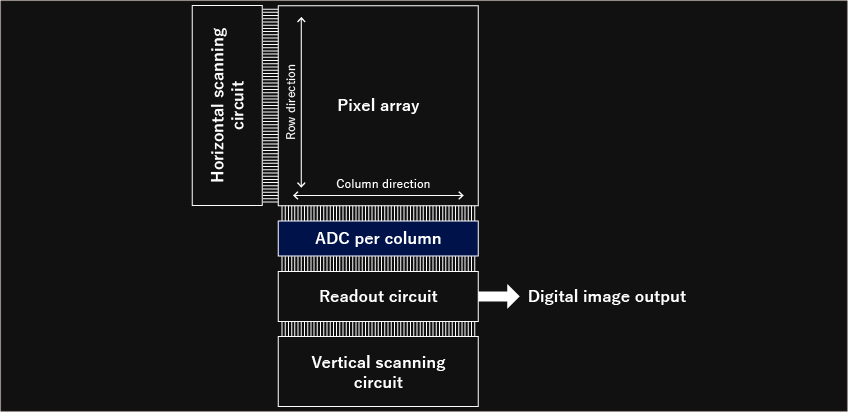
Figure 1: Column ADC
Serial ADC
Serial ADCs use one or several ADCs after the readout circuit at the bottom of the pixel array for sequential readout.
| Features |
|
|---|---|
| Trade-offs |
|
| Applications |
|
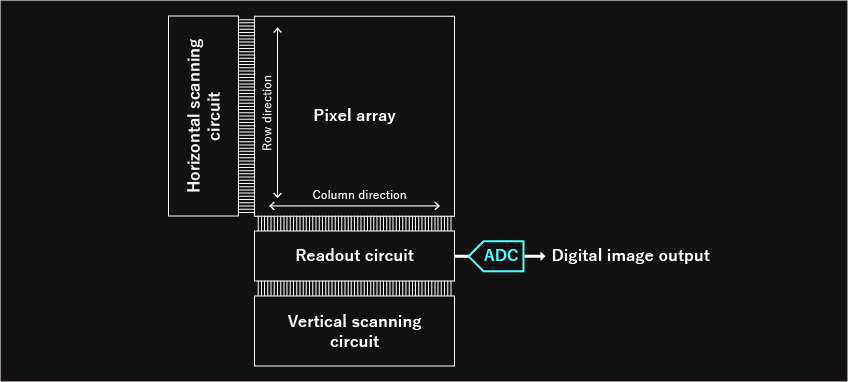
Figure 2: Serial ADC
The design of the high-precision ADC techniques (pipeline, SAR, ΔΣ, etc.) selected for serial ADCs is an important technological foundation for image sensors, which require high resolution and a wide dynamic range.
Our semiconductor analog design business specializes in high-precision ADC technology.
Our semiconductor analog design business specializes in high-precision ADC technology.
Custom design services leveraging our silicon-proven ADC IP and image sensor expertise
We combine our many years of CIS design experience with silicon-proven ADC IP that has been fully verified on actual chips to provide custom design solutions tailored to our customers' needs.
As the image sensor market diversifies, the required characteristics are becoming more complex. In particular, fields other than mobile (automotive, industrial, medical, etc.) require high-precision ADCs, and their design requires a high level of expertise. Our core competency lies in the design of high-precision ADC types such as pipeline, SAR, and delta-sigma, which are strengths of serial ADCs.
Our silicon-proven ADC IP has been fully verified on actual chips, offering the important benefit of not only superior performance but also significantly shortening development time. By combining these technologies with our image sensor expertise, we provide unique solutions that meet our customers' diverse needs.
As the image sensor market diversifies, the required characteristics are becoming more complex. In particular, fields other than mobile (automotive, industrial, medical, etc.) require high-precision ADCs, and their design requires a high level of expertise. Our core competency lies in the design of high-precision ADC types such as pipeline, SAR, and delta-sigma, which are strengths of serial ADCs.
Our silicon-proven ADC IP has been fully verified on actual chips, offering the important benefit of not only superior performance but also significantly shortening development time. By combining these technologies with our image sensor expertise, we provide unique solutions that meet our customers' diverse needs.
Custom Design Services for Image Sensor
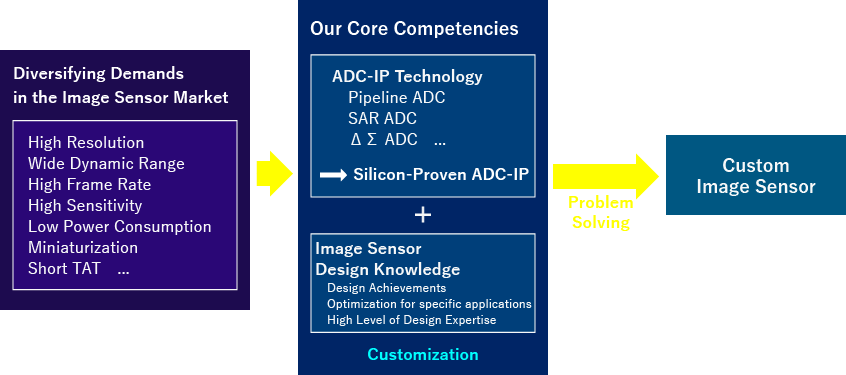
We help customers balance their desired performance (speed, accuracy, power consumption) with their time-to-market (TAT) by providing comprehensive support, from selecting the optimal ADC architecture (column or serial, and specific conversion method) to integrating and customizing silicon-proven ADC IP, helping them overcome analog design challenges in the development of next-generation image sensors.
Proprietary Silicon-Proven ADC-IP Lineup
SANEI HYTECHS offers a wide range of ADC IPs to meet diverse application needs.
Our Silicon-Proven IPs, verified on actual chips, reduce design risks and shorten development time.
Our Silicon-Proven IPs, verified on actual chips, reduce design risks and shorten development time.
| Element | Contents & Performance (Design Value) | Features |
|---|---|---|
| Pipelined ADC (PLADC) | Pipelined ADC 16bit 50MSps SNR=80dB, 184mW / 3.3V |
|
| Cyclic ADC (CYADC) | Cyclic ADC 16bit 8.5MSps SNR=81dB, 57mW / 3.3V |
|
| SARADC | SAR-ADC 12bit 10MSps SNR=69dB, 1.7mW / 1.8V |
|
| OS-SAR ADC (SAROS) | OverSampling-SARADC 16bit 125kSps SNR>84dB, 1.3mW / 1.8V |
|
Information as of April. 2026.
Please check the following links for the latest information.
Please check the following links for the latest information.
Analog IP Customization/Porting Service
Based on analog IP, we offer customization to meet customer needs and porting to specified foundries.
Compared to developing new analog circuits, we provide optimal IP solutions in a short period while reducing development costs.
We propose full custom design and process porting depending on the application.
Flexible IP deployment compatible with various processes supports shorter development times and smooth product realization.
For details, please feel free to contact us.
Compared to developing new analog circuits, we provide optimal IP solutions in a short period while reducing development costs.
We propose full custom design and process porting depending on the application.
Flexible IP deployment compatible with various processes supports shorter development times and smooth product realization.
For details, please feel free to contact us.