![[Image]SANEI HYTECHS](/en/shared/img/logo_w.png)
Improving AI Accuracy with High-Quality Annotation: Comparing In-House vs. Outsourced Options and How to Choose
2026.10.09
- 人工知能(AI)
In developing AI (artificial intelligence) using deep learning, many developers struggle to improve the accuracy of their models.
The underlying issues such as "accuracy plateauing even with algorithm improvements" and "failure to reduce misrecognition" are related to the quality of the annotation data used for training. This article compares in-house versus outsourced annotation for AI developers who are facing challenges in improving AI accuracy and managing the structure and costs of annotation work. Simply put, outsourcing annotation work to a dedicated team offers superior cost performance. And the optimal solution that covers the drawbacks of outsourcing, such as "variability in quality" and "security concerns," is SANEI HYTECHS's annotation business. With a proven track record of over 11 years, SANEI HYTECHS's annotation business has established a double-check and 100% inspection system managed entirely by a dedicated team of full-time employees, achieving data creation that balances low cost and high quality.
This article details the structure and strategy of our annotation business.
This article details the structure and strategy of our annotation business.
An annotation system to improve the accuracy of AI models
To quickly resolve the challenges of AI development, we will first address concerns about outsourcing and explain our annotation system and its features, which dramatically improve the accuracy of AI models. When considering outsourcing annotation, many AI developers are concerned about "variability in delivered data quality," "security risks such as information leaks," and "communication discrepancies." At SANEI HYTECHS, we resolve these issues through our unique operational structure.
1. A stable, dedicated system powered 100% by "full-time employees" with over 11 years of proven track record
In general annotation outsourcing and crowdsourcing, tasks are often handled by short-term cloud workers or part-timers, leading to quality inconsistency due to high staff turnover. Our Vietnamese subsidiary, "SANEI HYTECHS Vietnam," boasts a track record in the annotation business spanning over 11 years. All operating staff are employed as "full-time employees." Long-term employment allows project know-how to accumulate and continuously improve, maintaining high-level and uniform annotation quality.
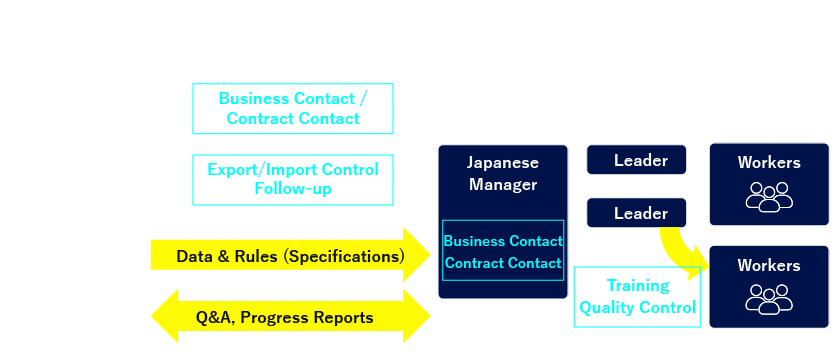
Business Structure
2. Maintaining "High Quality" through Double-Checking + 100% Inspection
Incorrect data labeling, positional misalignment, and rule violations are major factors impeding AI learning. We maintain quality through the following quality controls:
Thorough rule training and translation
We translate client specifications and rules locally, educating all operators and inspectors.
Immediate sharing of questions
Q&As arising during tasks are promptly confirmed with the client, and answers are shared across the entire team.
Double-checking by leaders
After workers complete their tasks, a double-check is conducted by leaders and inspectors.
100% inspection prior to delivery
Rather than sampling inspections, we conduct a 100% inspection before delivery.
Inspection results and feedback are shared among checkers to prevent dependency on individuals and ensure uniform standards.
Inspection results and feedback are shared among checkers to prevent dependency on individuals and ensure uniform standards.
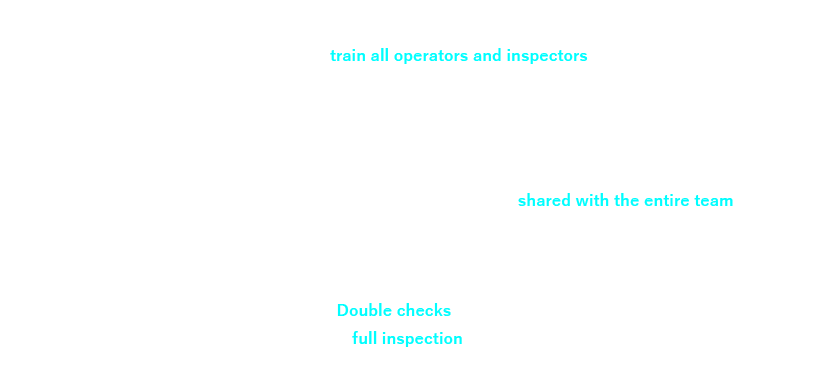
Rigorous Quality Management System
3. Achieving "Low Cost" through Vietnam offshore operations and a flexible cost structure
By leveraging a dedicated team at our subsidiary in Vietnam, SANEI HYTECHS achieves low pricing that is difficult to realize within Japan. Costs are handled flexibly either on a unit price basis (cost per point, shape, or class) or a labor basis (cost per worker or leader). Furthermore, for new projects, we offer free trials using sample data, allowing you to experience our high annotation quality firsthand in advance.
4. Robust security system and Japanese support
Offline environment
All work PCs operate in an offline environment, with zero involvement of cloud workers.
Physical security
We enforce strict security including fingerprint authentication doors, surveillance cameras in offices and meeting rooms, and a total ban on bringing communication devices (smartphones, etc.) into the facility.
Japanese and English support
Japanese managers are permanently stationed on-site, providing smooth communication channels and project management.
SANEI HYTECHS's annotation system resolves outsourcing risks through a "dedicated team of full-time employees," "double-checking and 100% inspection," and "thorough security," delivering low-cost, high-quality training data.

No communication devices permitted on the premises
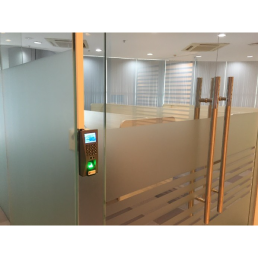
Adoption of security doors with fingerprint authentication
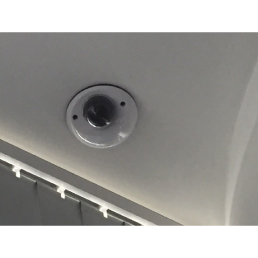
Installation of surveillance cameras in offices and meeting rooms
The relationship between supervised learning and annotation: Why quality affects model accuracy
This article explains the mechanism behind the high importance of annotation quality in AI development, from a technical perspective of supervised learning. Supervised learning—a core learning method in deep learning that forms the foundation of AI development such as image recognition and object detection—is a technique where paired input data and corresponding "ground truth labels" are fed into a model to learn the associations for predicting correct outputs from inputs.
Basic Flow of Supervised Learning
[Input Data (Images/Videos)] + [Ground Truth Labels (Annotations)]
AI Model Training
Trained Model Performance
Garbage In, Garbage Out
No matter how excellent an AI algorithm is, if the training annotation data contains defects (noise) like those below, the model's accuracy upper bound (Performance Ceiling) will be severely restricted.
Ambiguity of boundaries
The bounding box (rectangle) is misaligned with the object.
Label inconsistencies and errors
Data that should originally be labeled "pedestrian" is labeled as "obstacle."
Variance in standards among annotators
One person includes shadows in the annotation, while another excludes them.
Models trained on noisy training data learn incorrect patterns, leading to frequent misrecognitions and missed detections during real-world inference. To improve model accuracy, "uniform and high-quality annotation data" is far more essential than tweaking algorithms.
Image and video annotation techniques and their mapping to model tasks
For the image and video annotation domain we handle, optimal techniques exist according to the target model task.
*Our service scope specializes in "image/video data" where high precision management is required, thereby elevating our expertise and quality.
*Our service scope specializes in "image/video data" where high precision management is required, thereby elevating our expertise and quality.
Rectangle (2D BBox)
| Main features | A basic technique of enclosing an object in a rectangular frame. |
|---|---|
| Related AI model tasks and application examples | Object detection (vehicles, pedestrians, signs, pharmaceutical packaging inspection, etc.) |
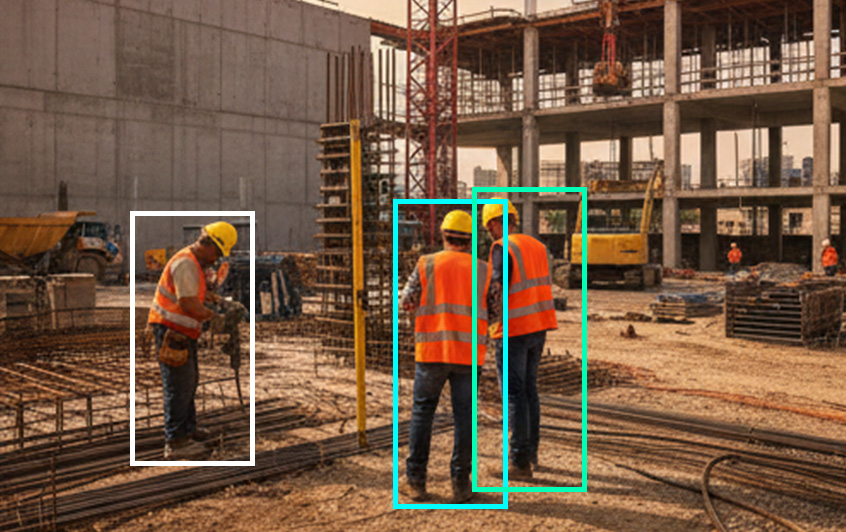
Person detection
3D BBox
| Main features | A method of enclosing an object, including its depth and three-dimensional structure, in a rectangular prism. |
|---|---|
| Related AI model tasks and application examples | Autonomous driving and approaching vehicle detection using LiDAR and camera images. |
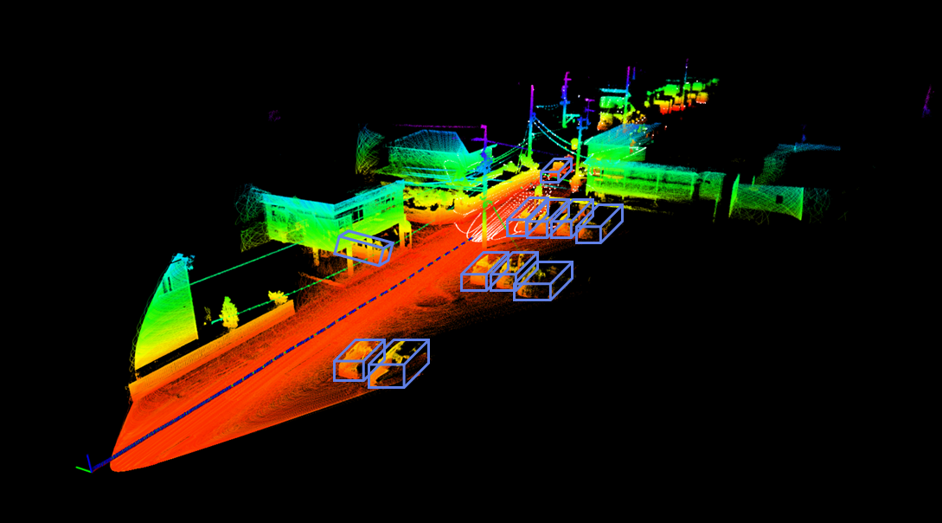
Annotation on LiDAR imagery
Segmentation
| Main features | Precisely color-coding object boundaries at the pixel level. |
|---|---|
| Related AI model tasks and application examples | Road and lane type determination, anomaly detection (defects, foreign objects, etc.), path planning. |
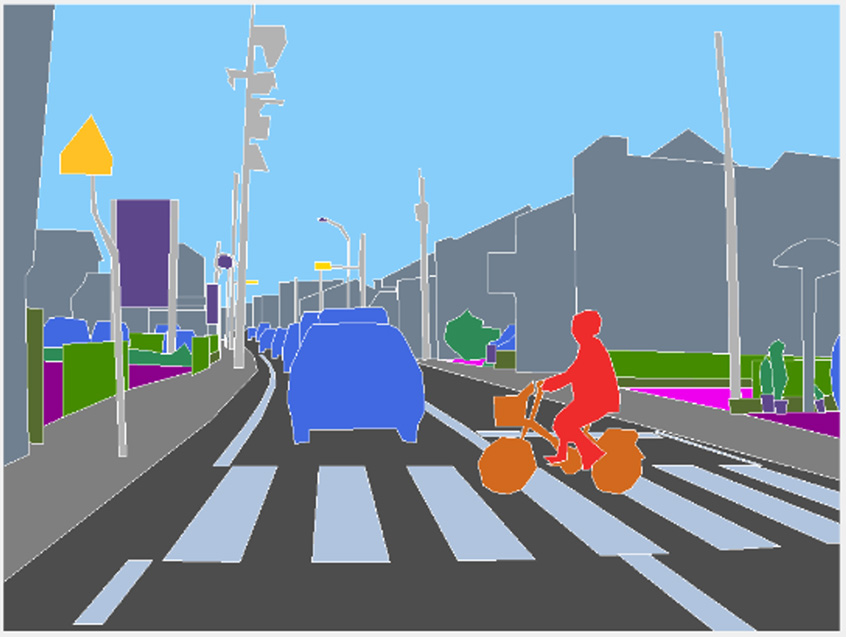
Semantic segmentation on in-vehicle imagery
Keypoints
| Main features | Placing points on object joints and key feature locations. |
|---|---|
| Related AI model tasks and application examples | Human posture estimation (factory worker movement flow analysis, patient condition change detection in hospital rooms). |
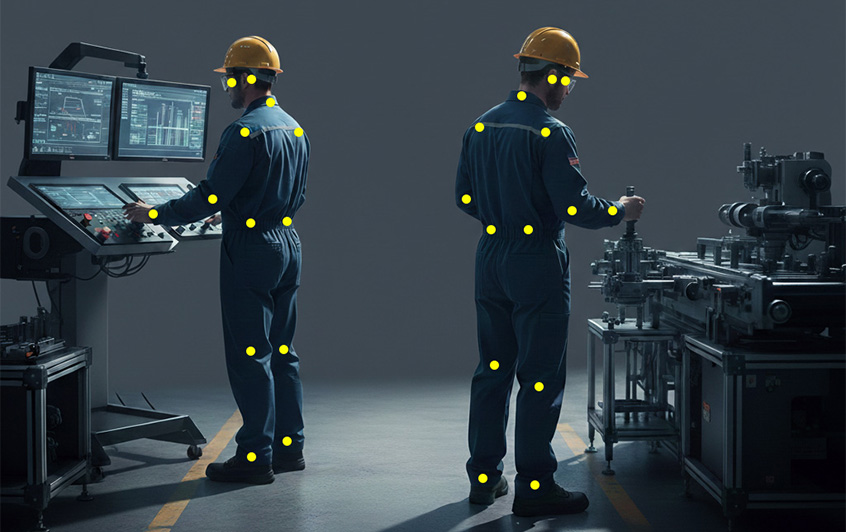
Pose estimation
Image classification and attribute tagging
| Main features | Adding tags and attribute information to an entire image or specific frames. |
|---|---|
| Related AI model tasks and application examples | Weather classification, status determination. |
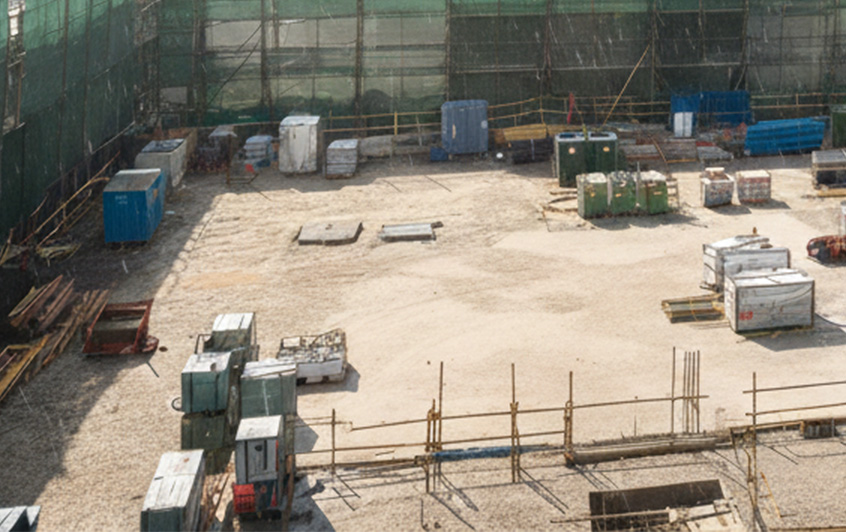
Image classification and metadata annotation(Sunny)
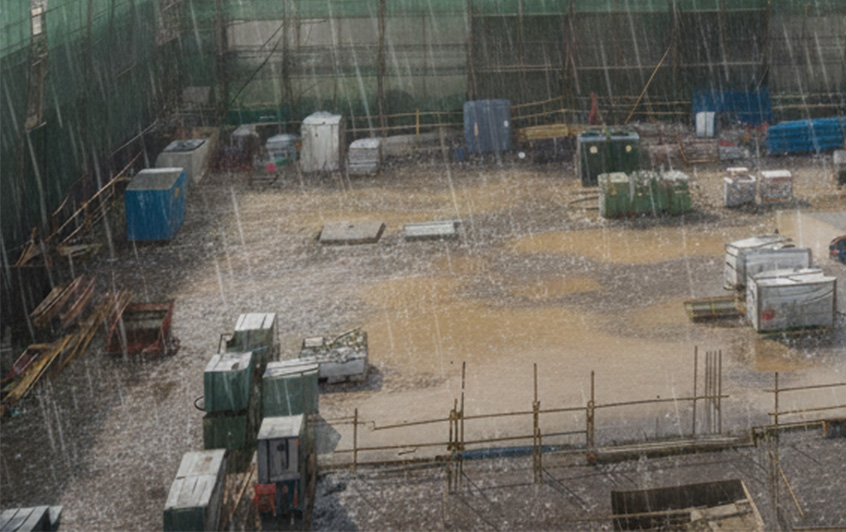
Image classification and metadata annotation (Rainy)
In supervised learning, annotation quality is a crucial factor that determines the upper limit of model accuracy.
Advantages and disadvantages of bringing annotation work in-house
This analysis examines the advantages and operational limitations of having client development members or internal staff handle annotation work in-house. In the early stages of AI development (such as PoC), in-house annotation is frequently adopted due to its ease of setup.
Advantages of In-House Annotation
Immediate responsiveness to specification changes
When annotation rules change frequently during the model verification phase, operating procedures can be modified and corrected immediately within the company.
Accumulation of domain knowledge and know-how
For data requiring specialized, proprietary industry knowledge, expertise can be built up directly within the company.
Disadvantages and Challenges of In-House Annotation
As projects progress and data volume grows, in-house execution transforms into a severe bottleneck.
Pressure on engineer workload
AI engineers and researchers lose valuable time to vast amounts of manual annotation, delaying algorithm development and verification tasks that should be their primary focus.
Quality inconsistency and lack of inspection structure
When work is performed by a small group of internal staff, establishing a clear double-check system and inspection criteria is difficult, resulting in data variance across workers.
Scalability limits and workload fluctuation
Securing resources to create tens of thousands to hundreds of thousands of annotated images needed for training is difficult. Moreover, hiring staff to match development cycles (peaks and troughs) imposes a heavy cost burden.
While in-house annotation is effective for small-scale data in early development, it reaches its structural and cost limits during the mass production phase.
Advantages, disadvantages, and risk management of outsourcing annotation work
This article explains the advantages of outsourcing annotation work to external specialized vendors, as well as the disadvantages and risk countermeasures to keep in mind.
Outsourcing is the most effective means for rapid resource expansion and cost reduction.
Outsourcing is the most effective means for rapid resource expansion and cost reduction.
Advantages of Outsourcing
Increased cost efficiency
Compared to internal engineer labor costs, large volumes of data can be created at low cost in a short period.
Engineers focus on core tasks
By outsourcing annotation work, internal engineers can concentrate fully on AI development and PoC evaluations.
Flexible scalability
Even when an additional surge of tens to hundreds of thousands of annotations occurs, scaling up a dedicated team makes it fully manageable.
Disadvantages of Outsourcing and Concerns in Vendor Selection
Selecting the wrong outsourcing partner gives rise to risks such as:
Quality defects and rework
If an outsourcing vendor has lax inspection procedures, delivered data will contain many errors, creating extra rework.
Security and information leaks
Data may leak to cloud workers or subcontractors, risking information exposure or unauthorized use.
Communication risks
When working overseas, language barriers and misaligned intentions risk delivering data that fails to meet specifications.
While outsourcing is optimal in terms of cost and speed, selecting a trustworthy partner with established quality control and security systems is essential.
*SANEI HYTECHS addresses all outsourcing disadvantages through a "full-time employee team in Vietnam," "double-checking and 100% inspection," "offline security," and "permanently stationed Japanese managers."
*SANEI HYTECHS addresses all outsourcing disadvantages through a "full-time employee team in Vietnam," "double-checking and 100% inspection," "offline security," and "permanently stationed Japanese managers."
Annotation Work: In-House vs. Outsourcing Comparison
We have summarized a tabular comparison between in-house development and outsourcing (general outsourcing vs. SANEI HYTECHS) across key criteria such as technical requirements, operational structure, and cost.
| Comparison items | In-house (handled within the client's company) | Outsourcing (crowdsourcing, etc.) | SANEI HYTECHS's Annotation |
|---|---|---|---|
| Accuracy assurance mechanism | Relies on individuals (difficult to build inspection system) | Mostly sampling-only inspection, leading to inconsistent quality | Rule translation and sharing, double-checking, and 100% inspection ensure uniform quality |
| Worker employment status | Internal employees and engineers | Unspecified crowd workers and part-timers | 100% full-time employees of Vietnamese subsidiary |
| Scalability | Low (limited resources) | High (capable of high-volume processing) | High (expandable according to requirements such as delivery deadlines) |
| Security | Secure under internal standards | Risk of leaks due to online operations, etc. | Fingerprint authentication, surveillance cameras, completely offline PCs |
| Communication | Extremely smooth | Language and intention misalignments are prone to occur | Permanently stationed Japanese manager (Japanese & English support) |
| Total cost | High (consumes engineer man-hours) | Low cost (however, risk of rework exists) | Low cost (unit-price model and labor-hour model) |
SANEI HYTECHS's annotation service meets a high standard across all aspects: operational stability, quality assurance, security, and cost performance.
To achieve improvements in AI model accuracy, ensuring the quality of annotation as training data is essential. If you have concerns regarding resource shortages from in-house operations or quality and security issues from outsourcing, please feel free to contact us. With over 11 years of proven track record, we offer low-cost, high-quality annotation data under a system of double-checking and 100% inspection by a dedicated team of full-time employees. Leveraging technical expertise cultivated under strict quality standards, including the automotive sector, we strongly support your AI development projects. First, please experience our quality through a free trial.